Since graduating high school, I have tried to live with as few regrets as possible and make the most of every opportunity that comes my way. That mindset was one of the reasons I decided to participate in the SJMC Japan study abroad program.
Although Japan was always a place I hoped to visit someday, I never imagined I would have the chance so soon. Combining two classes I needed for credits with the opportunity to study abroad made it an experience I knew I could not pass up.
History has always fascinated me. During my previous study abroad experience in London and Cambridge in 2024, I spent much of my free time exploring historical sites and feeding my Tudor obsession. I loved wandering off on my own to places like the Tower of London and Hampton Court Palace and imagining the events and people that once occupied those spaces.
I knew Japan would be completely different from those interests, but that was part of what excited me. I looked forward to learning about a culture unfamiliar to me, experiencing traditions I had only read about and comparing life in Japan to my own. Between its rich history, beautiful scenery and reputation for advanced technology, I knew the trip would be unlike anything I had experienced before.
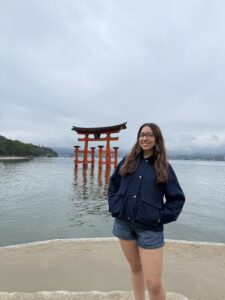
One of the most memorable outings was our visit to Daishōin Temple on Miyajima Island. Founded in the ninth century, the temple is one of the most important Shingon Buddhist temples in the region and is known for its many statues and spiritual sites. One part of the temple that stood out to me was the Henjokutsu Cave beneath the temple. Visitors make their way through the cave in complete darkness by feeling along the walls and path, symbolizing spiritual rebirth and renewal.
Walking through the cave was unlike anything I had ever experienced. I led my group through the darkness while trying to make sure nobody got left behind. The only things visible were illuminated illustrations along one wall, while the rest of the passage remained completely dark. Although I felt nervous because I could not see where I was walking, I also felt a sense of responsibility as everyone grabbed onto one another and slowly moved through together. Looking back, what stood out to me most was how unfamiliar and unique the experience felt. I remember thinking to myself that I was walking through a cave underneath a temple in Japan. It was one of those moments that made me stop and appreciate where I was, knowing it would be a memory I would never forget.
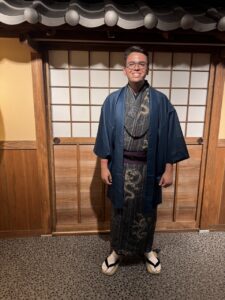
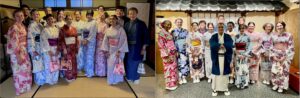
Another highlight was participating in a traditional tea ceremony at Kimono Tea Ceremony Maikoya in Kyoto. Before the ceremony, staff members helped each student dress in kimonos, and the women received beautiful hairstyles. I was amazed by the number of layers and ties involved in wearing the kimono, and I found the tabi socks and sandals surprisingly comfortable.
Once dressed, we entered a traditional tea room with paper walls, where we learned about the Japanese concept of ichigo ichie, which emphasizes cherishing each moment because no experience can ever be repeated exactly the same way. Rooted in Zen Buddhist philosophy, the ceremony focuses on harmony, respect, purity, and tranquility. Under the instructor’s guidance, we prepared our own matcha and enjoyed seasonal Japanese sweets. I struggled to get the matcha to the consistency it was supposed to have, but I enjoyed learning the process.
Sitting in the traditional tea room made me feel deeply connected to Japanese culture and history. I felt so beautiful wearing the kimono and having my hair styled, and learning about the history of how matcha came to Japan was fascinating. Participating in the ceremony and seeing how much care was placed into even the smallest details gave me a greater appreciation for Japanese traditions. It was one of the experiences that made me appreciate not only the beauty of Japan but also the significance behind its culture and history.
Another memorable stop was visiting Ichimonjiya Wasuke in Kyoto. Founded in 1000, it is recognized as Japan’s oldest confectionery shop and one of the world’s oldest continuously operating businesses. While there, I enjoyed tea and aburi mochi, small skewered rice cakes lightly roasted and covered in a sweet white miso sauce. As I sat traditionally and enjoyed my dessert, I thought about all the people who had sat there before me over the last thousand years. The food was delicious, and the kindness of the employees made the experience even more special.
One of my other favorite experiences was visiting Starry Flow Spa in Kyoto. I treated myself to a full spa package and left feeling completely relaxed. It was one of the most peaceful moments I had during the trip, and my hair had never felt softer or cleaner. The staff was incredibly kind, and I left feeling refreshed and grateful for the experience.
One of the biggest things I learned from this trip was the importance of telling stories. Before this program, many of my vacations existed only in memories and photographs. Through writing articles, creating social media content and interviewing fellow students, I realized how important it is to document experiences and preserve perspectives. Everyone experiences things differently, and sharing those experiences allows others to understand places and people they may never get to experience themselves.
Academically, I learned how to think on my feet while balancing facts with the thoughts and emotions of those around me. I developed stronger communication skills and became more comfortable conducting interviews and telling stories with accuracy, sensitivity and authenticity. I realized that storytelling is not just about sharing facts, but about helping people understand the experiences and emotions behind them.
Personally, I learned to appreciate experiences and traditions that contrast greatly with my own. Whether I was walking through a cave beneath a temple, preparing matcha or exploring cities with classmates, I was constantly reminded of how different daily life and customs can be from what I am used to. Many of the things that felt unfamiliar to me ended up being some of the experiences I enjoyed most. Being able to witness these traditions and ways of life gave me a new perspective and made me more curious about the world beyond my own experiences.
Now that the trip is complete and I am nearly finished with the program, I have spent a lot of time reflecting on my experience in Japan. This trip meant more to me than simply earning credits or traveling abroad. It gave me memories I know I will carry with me long after graduation.
Going abroad requires flexibility and an open mind, and this trip definitely challenged me in both areas. There were moments throughout the trip that were stressful and unexpected, especially when I lost my wallet and had to navigate those challenges while being in another country. Even though those moments were difficult at the time, they taught me how important it is to stay adaptable and make the best of situations that do not go according to plan. Looking back, some of those challenges became just as much a part of the experience as the memories and places themselves.
Professionally, this experience strengthened my communication skills and improved my ability to tell stories through writing and multimedia content. Through interviewing students, writing articles and creating social media content throughout the trip, I became more comfortable thinking quickly and communicating effectively. I also learned how to balance facts with people’s thoughts and experiences to tell stories in a way that feels authentic. I know the skills I developed during this program will help me in future classes and wherever my career takes me.
More than anything, this experience reinforced something I have tried to live by since graduating high school: taking advantage of opportunities when they present themselves. Looking back, participating in the SJMC Japan study abroad program is a decision I know I will never regret.
About The Author