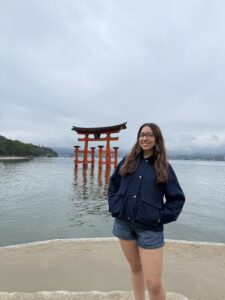
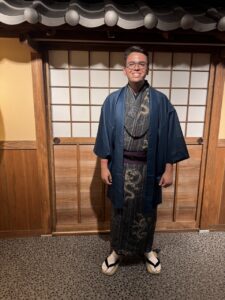
In their first full day in Hiroshima, the SJMC Japan team took a train and a ferry to Miyajima Island, exploring some of the famous and important shrines and temples, such as Itsukushima Shrine and Daishō-in. Afterward, one group climbed Mount Misen, the holy mountain on Miyajima, while another group shopped around town, trying not to get their items eaten by the deer around the island.

Famous for the “floating” and dramatic torii, Itsukushima Shrine was the chief Shinto shrine of the Aki province. Saeki Kuramoto erected it in 569 C.E. during the reign of Empress Suiko. Itsukushima means the “island of divine prayer,” while Miyajima means “shrine island.” While a shrine has been at the site since 1168, the torii gate that exists today is the ninth generation of the Otorii, built in 1875. The red color is to ward off evil spirits and grant good luck.
For many years, Miyajima was sacred—nobody could step on it until around 400 years ago. Today, Miyajima’s population is around 1,600 people, but births on the island have been historically prohibited. In addition, there are no cemeteries on Miyajima.
SJMC Japan students took a tour of Itsukushima Shrine while tour guide Michio Akutsu taught the team about some of the history behind the shrine and what’s inside. Akutsu even exorcised himself and the rest of SJMC Japan before entering.
Having seen pictures of Itsukushima Shrine previosly, digital media innovation senior Trinity Eilert has anticipated finally getting to see it for the first time in person.
“It was so cool seeing something so historically significant with my own eyes and not through a screen,” Eilert said.
Afterward, Akutsu took the SJMC Japan students to Daishō-in Temple, a historic Buddhist complex with many temples and statues on Mount Misen. Founded in 806 by Monk Kukai as a temple of the Omuro School. One temple is closer to the rest of the town, while another is near the top of Mount Misen.
At Daishō-in, the SJMC Japan students took off their shoes to enter the temple. They went inside a dark tunnel with dimly lit Buddhist icons in the walls. Going all the way through the tunnel symbolizes rebirth. Advertising junior Arman Hopkins even recited the mantra seven times while standing on Buddha’s footprints.
“I felt deeply connected with the spirits that were at the shrine itself, so basically, standing there is like a palate cleanser,” Hopkins said. “You are cleansing yourself of all things that signify negative energy, so by doing that you feel like God is by your side, helping you out, guiding you and then from saying those words seven times I felt that I was a part of it.”

During their free time, about half of the students climbed Mount Misen, the highest peak on Miyajima. Students took the cable car ropeway and then climbed up the steep steps of the rest of the mountain, but only a few made it all the way to the summit. The rest went as far as the Daishō-in Temple on Mount Misen. SJMC Japan Academic Program Director Gilbert D. Martinez especially enjoyed seeing the eternal flame.
“I was very grateful to see the eternal flame at Daishō-in Temple on Mount Misen on Miyajima and learn about its connection to the Flame of Peace at the Hiroshima Peace Memorial Museum,” Martinez said.
Before arriving at Miyajima Island, students and faculty took the ferry where they saw the Otorii from a distance on their way to the island. The ferry ride going smoothly pleasantly surprised digital media innovation senior Azuli Rodriguez.
“I loved the ferry!” Rodriguez said. “It was a great view and not a very unstable boat ride like I was thinking of.”

During their free time after the temple visit, many students went off on their own adventures. Some went shopping for goods, souvenirs and food around the island, others revisited Itsukushima Shrine to walk up to Otorii during the low tide in the afternoon.
The deer around the island especially awed the students: some decided to base their future assignments off them, some almost had their items eaten and others recorded goofy videos with them. One deer even walked into the ferry station, which a lot of SJMC Japan students found hilarious.
Before heading back to Hiroshima, human development and family science sophomore Cat Chan had a really funny plushie show-off battle at the train station with some high school students. After noticing a girl with a Chiikawa plushie, Chan pulled out the character merchandise she had bought earlier. The exchange quickly escalated as both continued to pull out toys to one up the other.
“Everyone was cheering and the girls were screaming at how I had so many plushies,” Chan said. “I gave them a heart with my hands to show them I loved it.”
After their excursion to Miyajima, the students prepared for the next day, where they will visit the Hiroshima Peace Memorial Museum and the Atomic Bomb Dome. Then, they will take the shinkansen to Kyoto—leaving Hiroshima behind.
About The Author