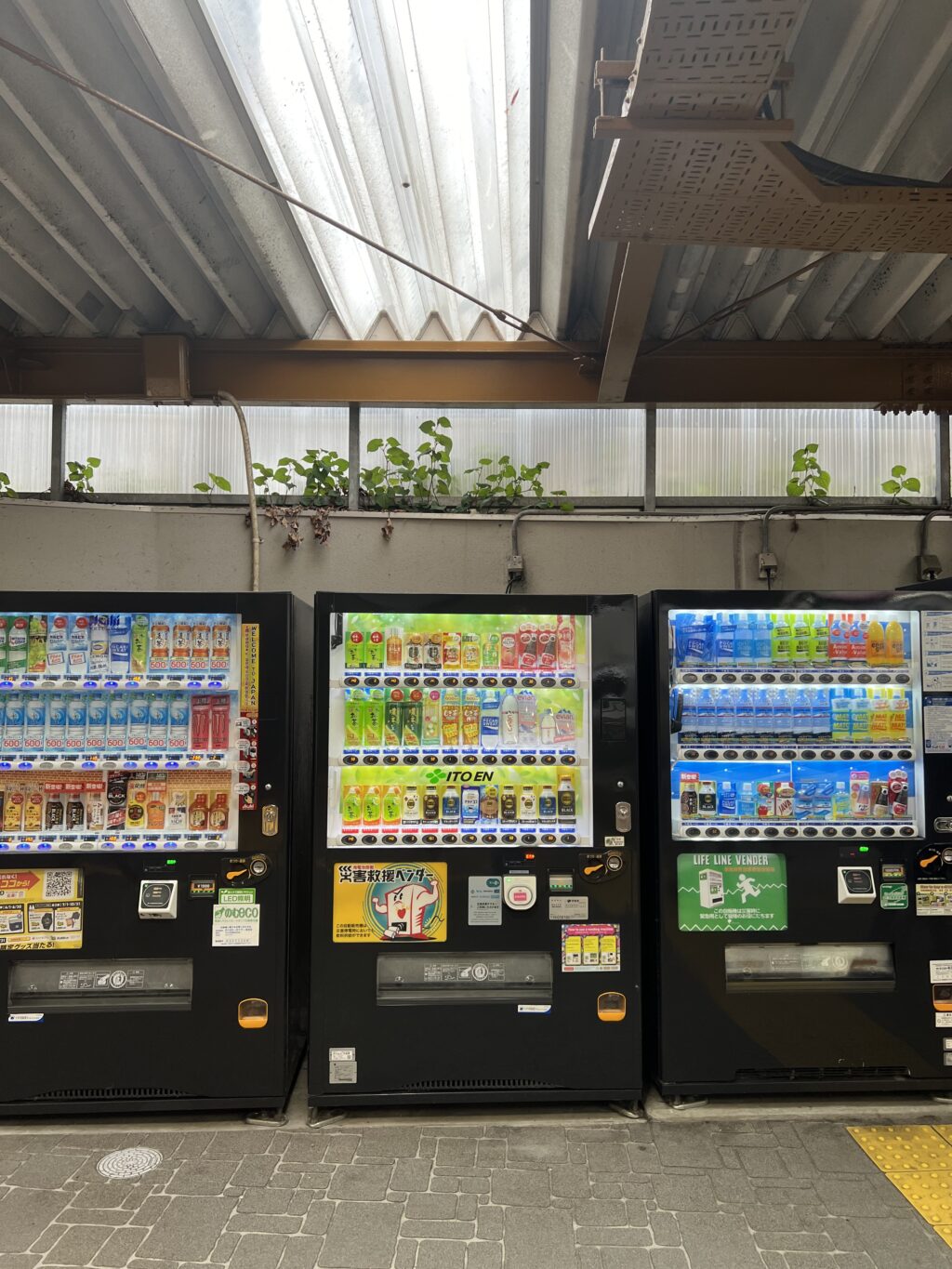
Vending machines found inside Tokyo's subway.
In the bustling city of Tokyo, innovation isn’t just a buzzword – it’s a way of life. The moment you step on the streets, you’re greeted with a multitude of inventions aimed at making life and daily tasks easier.
While some may seem simple, they can be considered the most important. Tokyo stands as a beacon of progress and ingenuity and is at the forefront of technological advancement. Let’s take a closer look at some of these ingenious solutions that have become essential parts of Tokyo’s urban landscape.
There are vending machines everywhere, and I mean everywhere! Every corner you turn, they are lined up waiting to give you drinks, snacks and so much more. Not only do they have such a wide variety (no two machines had the same items), but they were almost always fully stocked.
I’ve never encountered a vending machine in Tokyo that didn’t have what I wanted. They were a lifesaver when I needed water or a snack in a pinch, serving their purpose to the absolute fullest. Vending machines may seem mundane elsewhere. In Tokyo, however, they are a testament to efficiency and convenience.
Another very convenient thing in Tokyo is, of course, the convenience stores! Called konbini (borrowed from convenience), 7-Eleven, Family Mart and Lawson are around every corner, offering everything from snacks and drinks to household essentials and fresh meals.
The checkout process is remarkably quick and efficient, often using self-service kiosks. There is usually someone who staffs the counter and scans your items, and then you pay either with a card or feed cash into the machine, and it dispenses your change. It is a very quick process, something that I was not ready for the first time I checked out. With over 50,000 of these convenience stores scattered across Japan, they dominate the landscape. You can’t walk down a street without coming across one, along with several other helpful innovations.
Sometimes crosswalks can be frustrating, especially when it seems like you’re waiting forever to cross the street. Japan has found the easiest solution for this! Crosswalk countdowns. When I saw one for the first time I was blown away at how this simple invention made all the difference. With large digital displays indicating the seconds remaining before the light changes, pedestrians can plan their crossing with precision, ensuring a safer and more efficient flow of foot traffic. I think that this is also why there aren’t as many jaywalkers on the streets. There’s no reason to be in that big of a hurry when you can simply look up and see how much time is left till crossing time.
Continuing with pedestrian innovation in the city, the streets are covered with markings and signs to guide people on the most efficient paths. Whether it’s designated lanes for walking or arrows indicating the direction of foot traffic, these markings ensure that pedestrians can navigate the city with ease, minimizing congestion and improving movement as a whole.
Experiencing this firsthand on the first day was surreal. Going down into the train stations, I expected it to be an insane and confusing mess, but it was close to the complete opposite. People respect these signs because they are effective when followed. Compared to places in the States, specifically New York City, the subways are always a hectic mess that has people pushing and shoving their way through everyone. Now that could be more than a lack of directional signs, but comparatively, Tokyo has more organization when it comes to large public settings, and it is thanks to signs like those.
As someone who finds it hard to navigate in places with large crowds, I enjoyed all of the pedestrian markers. Tokyo’s pedestrian markings exemplify efficiency and innovation in urban design. These markings, often found on sidewalks and footpaths, help to regulate pedestrian flow by indicating which side to walk on. In most places, it will be to the left.
What sets these markings apart from places elsewhere is their clarity and consistency with bold and easily visible signage. If there are signs with words on them, they are usually found to have multiple translations on them catering to foreigners. This system works exceptionally well due to its simplicity and widespread adherence by residents and visitors alike. They enhance overall safety and efficiency, particularly in crowded areas like train stations and shopping districts.
Each of these innovations serves as a testament to Japan’s dedication to enhancing the everyday experiences of its people. In a country where attention to detail is paramount and efficiency is revered, these seemingly mundane inventions stand as pillars of innovation, and some would even say are the backbone of the technological advancements that are being made.
About The Author