I wanted to go to Japan because I love stories, and I want to be better at telling them.
Japanese stories, especially video games and manga, have greatly inspired and encouraged me along my path and shaped how I want to live my life. I’d seen Japan depicted in so many of these stories, and I looked forward to actually experiencing these places that I always thought would be out of reach. I especially looked forward to being able to just get lost in a new environment (a wish that was definitely fulfilled in Hiroshima).
As excited as I was to go to Japan, I also knew the classes I would be participating in were going to be challenging but rewarding. In travel writing, I would be working with tighter deadlines than I ever had before, with a type of writing I was unused to. Sometimes, I’d also be writing with a partner and an editor, which I had never done before.
Even though I consider myself a good writer, I was still daunted, to say nothing of the other class, mobile storytelling. I had never posted much on social media, so I was treading on uncharted territory. My first time posting to a public account that represented the whole SJMC Japan program was nerve wracking, to say the least. Looking back, I think these are some of the most valuable classes that I’ve taken at Texas State University.

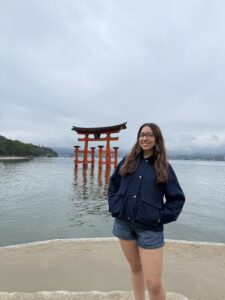
Some of my favorite sites we visited were the Shinto shrines and Buddhist temples. Seeing these ancient holy places in such good condition was amazing. Itsukushima Shrine was my favorite of these sites, with its view of the floating O-Torii gate and stunning vermilion paint. Miyajima Island was definitely my favorite day trip. These sites made me reflect on the importance of taking care of your possessions.

Exploring Tokyo, Hiroshima and Kyoto on my own was incredibly fun. Getting your bearings in a new place, especially a city, is such an amazing feeling. Walking around, I was able to feel a confidence that I rarely feel at home, even when I got lost in Hiroshima. That confidence extended to how I was able to present myself. As a transgender woman, I’m often not able to present the way I want to in Texas, but in Japan, I felt safe enough to be myself.

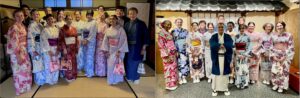
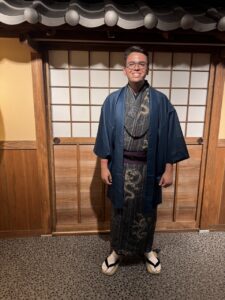
The tea ceremony where we all wore kimonos was a truly special experience. I was worried about whether or not I’d have to share a changing room with men and what kind of kimono I’d be able to wear, and if I’d cause a scene. All of my worrying was for nothing, though, because the accommodations I received were truly amazing. A single person space was set up for me and I was able to wear a beautiful woman’s kimono. During the parts I needed help (which was most of the process), I didn’t feel like I was treated any differently than anyone else. The tea ceremony was also amazing. The matcha we drank was delicious, as were the sweets we ate beforehand. I was able to feel fully in my skin and that confidence stayed with me for the rest of the trip.


I also loved getting to explore authentic Japanese food. My favorite meals came from a ramen shop near our hotel in Tokyo and a curry stall in Kyoto, but onigiri (rice balls) from the grocery store for breakfast will always have a soft spot in my heart and stomach.


Speaking with professionals in the field I wish to pursue was also an incredibly gratifying experience. Journalist Mayu Yoshida was an especially early highlight of the trip. She discussed her journey as a journalist, from college, through Bloomberg, all the way to starting her own business, Better Media Tokyo. She shared invaluable insight into the profession as well as the difference in work cultures between Japanese and international newsrooms.
Yuriy Humber, the founder of Yuri Group, a strategic energy industry information firm, also shared information about his own path, Japanese work culture and career advice.
Both speakers emphasized the importance of human connection in journalism. In an age of uncertainty in the field due to artificial intelligence, the confidence with which they assured us that AI was unable to replace a real journalist was comforting.
“When content becomes infinite, trust becomes scarce,” Yoshida-san said.
The importance of versatility, quick thinking and curiosity were consistent talking points between both presenters. The importance of multimedia skills were also stressed.
I had often felt uncertain about my future. I was unsure if I would be able to find work in journalism and if that was what I even wanted to do for my career. Now, having heard Yoshida-san’s and Humber’s stories, I’m sure. While I’m still concerned about the things that are out of my control, I know that if I work hard, I’ll be alright in the end.
I was able to put that newfound conviction to the test on my way home. I extended my trip by a day, which meant I needed to find my own way to the airport all on my own. I had to adapt to multiple unexpected challenges as I made my way from my hotel in Kyoto to the airport in Osaka, and then at the airport, but I made it to my gate with 20 minutes left to spare.
Before I left for Japan, I was worried about a lot of things. Would I get along with my fellow students? Would I be able to keep up with the workload? Would Japan be everything I dreamed it would be? What comes next? There were times where I thought about backing out, just in case I didn’t like the answers, and I’m so glad I didn’t. Japan taught me that I don’t know what the future has in store, but I have what it takes to weather the storm.

About The Author