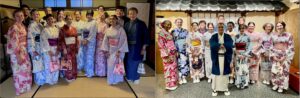
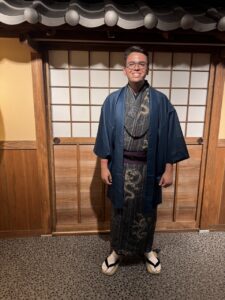
Long anticipated by SJMC Japan students, the third day in Kyoto ended with a traditional Japanese tea ceremony, complete with full kimonos, in the heart of this former capital of Japan.
Arranged by program provider Asia-Pacific Academic, students donned kimonos, a traditional Japanese garment that has evolved into the formal attire for special occasions with assistance from the staff at Maikoya Kyoto.
Kimonos serve as a visual representation of respect, harmony and formality, connecting the group with the ceremony’s history and tradition. Many students were eager to experience wearing a kimono, and Stefan Chupp, a digital media innovation senior, shared his excitement when he looked into the mirror for the first time.
“When I realized we were going to wear kimonos, I got so excited,” Chupp said. “I started thinking about what colors I should wear and if I should match with my friends.”
The Japanese tea ceremony, or chadō, is a spiritual practice that aims to create a sense of balance and unity among the host, guests and environment. It involves the physical cleansing of the tearoom and utensils, as well as a symbolic purification of the mind and heart. SJMC Japan witnessed their host Minami begin the cleansing ritual, watching in awe at her precise and elegant process.


Students went through the process of whisking their matcha with Minami guiding them step by step through the careful practice—talking about the history and traditional ways to sit, eat and drink when in a Japanese tea ceremony. SJMC Japan loved the tea ceremony.
Professor of Instruction Jon Zmikly, who has been part of three SJMC Japan programs, shared his joyful experience.
“I think the tea ceremony gave students a rare glimpse into a deeper side of traditional Japanese culture,” Zmikly said. “I loved how it was so interactive and informational.”
After the tea ceremony, Amanda Cabrera, an electronic media junior, shared her gratitude of being able to experience a Japanese tea ceremony for the first time.
“We are the first class that got to experience a tea ceremony while wearing kimonos,” Cabrera said. “It feels great to have experienced this once-in-a-lifetime opportunity.”

Before experiencing the tea ceremony, tour guide Michio Akutsu guided students to Kyoto Shimbun News, where newspaper employee Midori Dei and interpreter Hayahide Sato greeted and spoke with with students before taking them on a tour of the building.
With 470 workers, Kyoto Shimbun News is full of busy employees publishing morning and evening editions to over 310,000 people every day. The tour reviewed the newspaper’s long history and how they got here after releasing their first edition on June 9, 1879.
After touring the newspapers editorial and photography departments, SJMC Japan got to interview journalist Mr. Kubota. After being asked for advice as upcoming journalists and storytellers, Kubota answered with a heartfelt and inspirational message.

“Do not hesitate to learn and study everything [and] be sure to keep many interests,” Kubota said. “Travel, see and feel the many different cultures and experiences. You never know what you may write about.”
As their visit came to an end, they were surprised with a newly printed news page with their group picture on the front, under the headline “Welcome to Kyoto Shimbun News, Texas State University.”
After visiting the newspaper, the SJMC Japan team visited Kinkaku-ji, a Buddhist temple built by Ashikaga Yoshimitsu, the third shogun of the Muromachi Shogunate. Kitayama culture, otherwise known as northern mountain culture, was heavily impacted by Zen Buddhism, which focuses on meditation and self-discipline. Kinkaku-ji is home to a beautiful golden temple of three floors, each with their own architectural theme of Shinden (a style created in the Heian period), Bukke (samurai style) and Zen Buddhism. Students were able to see the bonsai tree of Yoshimitsu, now a giant pine tree named Rikushu no Matsu that’s more than 600 years old.


Ending with some much-needed dinner and free time after a long day of activity, students continued to explore Kyoto, preparing for their last full day of adventure and getting ready to finish off their SJMC Japan experience tomorrow.
About The Author