On their first full day in Kyoto, the SJMC Japan team ventured to two of the oldest Buddhist temples and Shinto shrines: Kiyomizu-Dera and Yasaka Shrine.
Tour guide Michio Akutsu decided to avoid the crowds that have plagued Kyoto in recent years by leading the group along a quiet street next to the Higashi Otani Cemetery. Students were taken aback by how enormous it was. The Buddhist cemetery wrapped around the hillside with the graves taking up the steep slope.
Peyton Bayne, an electronic media senior, observed something interesting about the site.
“The main thing that I noticed was how compacted it was together,” Bayne said. “This is because Japan wasn’t a large country. Eight hundred years ago, Japan started cremating a lot of the dead. They had to put them in a small area to fit all of them during that time.”

Rain started to pour as the group made it to the temple. Umbrellas filled the site, which wasn’t suprising as it is Japan’s rainy season known as tsuyu or “plum rain.” The first thing the team saw was Kiyomizu-dera, a Buddhist temple well-known for its large wooden stage that stands 13 meters (about 43 feet) above the hillside. Kiyomizu-dera, built in 778 A.D., is also a UNESCO World Heritage Site.
At the bottom of the complex lies a waterfall with three distinct pathways. According to guide Akutsu, the waterfall has never run dry in 1,200 years. Buddhists have claimed that the water will cure any illnesses that a person may have. Furthermore, drinking from the streams is said to bring good luck in school studies, love and health and longevity.
The tradition consists of using a metal rod with a cup at the end to reach the desired waterfall stream and drink the water; students got the chance to go up and try it for themselves, hoping to fulfill their wishes.

Afterward, students navigated Matsubara-dori, a popular shopping street, as they made their way to Yasaka Shrine. The lines of stores contained a variety of specialty shops and restaurants, some even being over 400 years old.
Azuli Rodriguez, digital media innovation senior, loved her experience.
“First of all, I appreciated that it was rainy instead of super-hot,” Rodriguez said. “I was able to see a lot of beautiful views when we were traveling and although it was crowded, it was so beautiful to get the experience of walking around and seeing the shrines.”
After the visit to the cultural sites, the team broke up into different groups to venture out into Kyoto. Two students went to Arashiyama, visiting the monkey park and the bamboo forest in their free time.
The park is inhabited by over 120 Japanese macaque monkeys, which are endemic to Japan. Graduate student Angie Vasquez was thrilled to feed the monkeys peanuts and apples through a cage.
“Apparently, the birth season was from April to July. So, when we went, there were a lot of babies around,” Vasquez said. “I also didn’t expect them to be so soft! Tell me why a monkey’s hands are softer than mine.”
She highly recommends the experience to anyone who gets the chance.

Amanda Cabrera, electronic media junior, especially enjoyed her experience at the bamboo forest, which is considered one of Kyoto’s top sights.
“I worried it was going to be crowded, but I think the rain beforehand made people not go and so it was great,” Cabrera said. “The weather was nice, and the bamboo was so beautiful to see in person.”

After visiting the best of both worlds, students returned to the hotel to get some quality rest and work on class assignments.
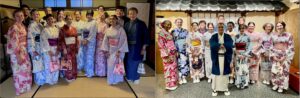
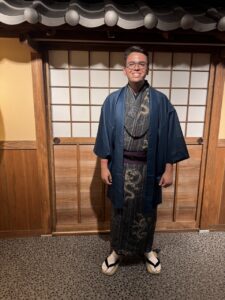
On tap for Thursday in the program, the SJMC Japan crew will go to Kyoto Shimbun (newspaper) and, Kinkaku-ji Temple, known as the Golden Pavilion. They’ll also take part in a Japanese tea ceremony, complete with kimonos!
About The Author