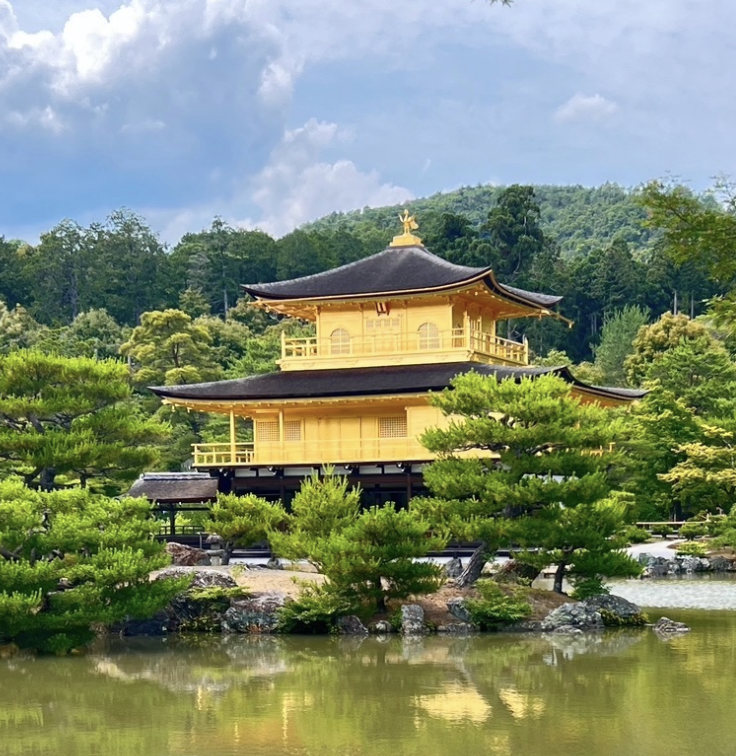
Despite June being the rainy season in Japan, a warm sunny day on a recent visit to Kinkaku-ji, the Golden Pavilion in Kyoto welcomed SJMC Japan.
There is a ticket booth sitting before the entrance to Kinkaku-ji, where a one-day entry ticket is available for purchase. Reservations are not needed, as there are no problems with overcrowding or ticket queues. The cost for an adult ticket is 500 JPY (about $3.40 USD), while a child ticket is 300 JPY (about $2.04 USD). Kinkaku-ji Temple takes no holiday breaks, so it stays open year-round from 9 a.m. to 5 p.m.
Because of the seasonably warm day, a mist machine greeted visitors as they stepped onto the temple grounds, helping them cool off in the summer heat before embarking on their visit. Although there are plenty of scenic views to enjoy while exploring, Kinkaku-ji Temple tells a story of deep historical significance through Buddhist culture.
Almost immediately after entering, visitors see the beautiful scenery of the golden temple overlooking a glassy pond known as Kyoko-chi. Kinkaku-ji was originally built in 1397 as a retirement house for Ashikaga Yoshimitsu, the third shogun of the Ashikaga shogunate. Following the death of Yoshimitsu in 1408, the then-retirement house became a Zen Buddhist temple, and a pine tree was planted in his honor. Today, the same pine tree rests on bamboo to support it from falling.

For years, the Golden Pavilion stood untouched until Hayashi Yoken, a monk in training, set it on fire. To this day, Yoken’s motive behind his act of arson remains unknown. The pavilion was later rebuilt in 1955, restoring the real gold leaf on the two upper floors.
Kinkaku-ji has a unique architectural structure, with each floor possessing its own meaning. The first floor represents the aristocratic elegance and noble life of Japanese society. The second floor reflects samurai style, and the third and final floor embodies the Buddhist Zen style. None of the floors are open for visitors.

Looking beyond the temple itself, it is important to focus on the surrounding pathways and nature. During the time of Yoshimitsu’s rule, shoguns and samurai were described as enjoying leisure time boating on Kyoko-chi. Moon viewing and occasional fishing served as traditions and sources of enrichment. Koi fish and carp swim throughout the same pond once used for leisure, providing a peaceful environment.


Continuing along the pathway of the garden lies a little spring, known as the “Milky Way Spring” or the Gingasen. This is a natural spring that continues to flow, spanning across centuries. Ashikaga Yoshimitsu used the water in the spring to make matcha during tea ceremonies over 600 years ago. Like the Gingasen, many structures represent Buddhist teachings and beliefs.
A waterfall near the Gingasen is known to hold multiple Buddhist meanings, as the stone residing in the middle of the water represents the transition from ordinary life to enlightenment. The gravel underneath the waterfall represents the completion of the journey to enlightenment. A legend behind the waterfall is that a carp swims up the waterfall against the current and perseveres to the top, turning into a dragon. This reflects the Buddhist belief that through life’s difficulties, one can reach the highest potential or enlightenment.
Gorintō, the five-stacked stone monument, is visible near the waterfall. This monument directly symbolizes the five basic elements of the universe in Buddhism:
- Earth
- Water
- Fire
- Wind
- Void
When put all together, these five elements represent the harmony and interconnection of humanity and nature in the universe in Buddhist teaching.

Kinkaku-ji’s Temple grounds include a teahouse from the Edo period (1603–1868), called Sekkatei. Since its construction, it has stood in contrast to the stunning Golden Pavilion by showcasing a simpler, more refined style. This teahouse reflects the Buddhist way of simplicity and balance in a beautiful way, with its display being the complete opposite of the extravagant Golden Pavilion. It is a representation of Japanese culture’s emphasis on balance.
Although Kinkaku-ji Temple remains a National Treasure and a tourist destination, it represents much more than that. It is a living history of not devastation, but restoration, not just a pretty sight, but a connection to nature and valuable Buddhist teachings.
Visiting this landmark is an experience to remember, with such rich history and appreciation for a deeply rooted culture.
About The Author